
From Reading List:
Conditional Design Workbook
By Andrew Blauvelt, Luna Maurer, Edo Paulus, Jonathan Puckey, and Roel Wouters
In Ghost in the Machine: Distributing Subjectivity, Andrew Blauvelt examined the term “conditional design” and compared it with early emerged theories like conceptual art. Two designers, Sol LeWitt and Karl Gerstner, have been discussed mainly in the texts to provide contexts and their viewpoints of conceptual art. Blauvelt has listed out the similarity between conceptual art and conditional design, which both LeWitt and Gerstner believe that the process of creating is a program that could open up possibilities and reduce the “randomness of approach that seemed both limitless and chaotic without it.” (Blauvelt, Maurer, Paulus, Puckey and Wouters, 2013, pp. iv). Then the discussion leads to whether the subjective exists in the process and where it is. According to Blauvelt, in conditional design, the subjective lives with the process, which suggests that the conditional design is an “open system”. The conditional design emphasises the input from others and responds to them. The theory of conditional design helped me better understand my project’s development process. My position is subjective, as well as others’ opinions and the process that I have been through is very much like what has been described in the texts as an open system. From Positions Through Iterating to Positions Through Contextualising, I am continuing to react and respond to the feedback from my surroundings, which the project, in a sense, can become a conditional design project.
On Patterns and Proxies, or the Perils of Reconstructing the Unknown
By Wendy Hui Kyong Chun
The article discusses the proxies, “stand-ins or representatives” (Chun, 2018), which have been presented and viewed with different purposes and the controversy that they provoked. The debate around Dr Michael E. Mann’s “hockey stick” is given as an example to indicate the role of proxies in social and political contexts. According to Chun, while suggesting messages, proxies respond to the unknown by bringing in more questions. In other words, the image could cause controversy. In the end, the article suggests that the proxies introduce the unknown from existing knowledge. Therefore, the image and proxies are like the scope for us to reach the future. In a sense, the viewpoint of this article reminds me of the All Possible Futures: (Un)Realized Projects (Sueda), which could be understood as a series of projects that indicate the possibilities of future images.
Own Research:
The Age of Earthquakes: A Guide to the Extreme Present
By Shumon Basar, Douglas Coupland, Hans Ulrich Obrist
The book introduces and reflects on the present world as the age that humanity is somehow shaped by the media that surround us, like the internet(technology), and gives some ideas of what the future could be like. The Age of Earthquakes is designed to contain many images and slogans, and the format reflects the content. Reading through this book is like viewing social media online. The texts are simple and direct but provide the authors’ perspective about the current society, which is to express the madness of how human’s life has become due to the new media and technology we have developed.
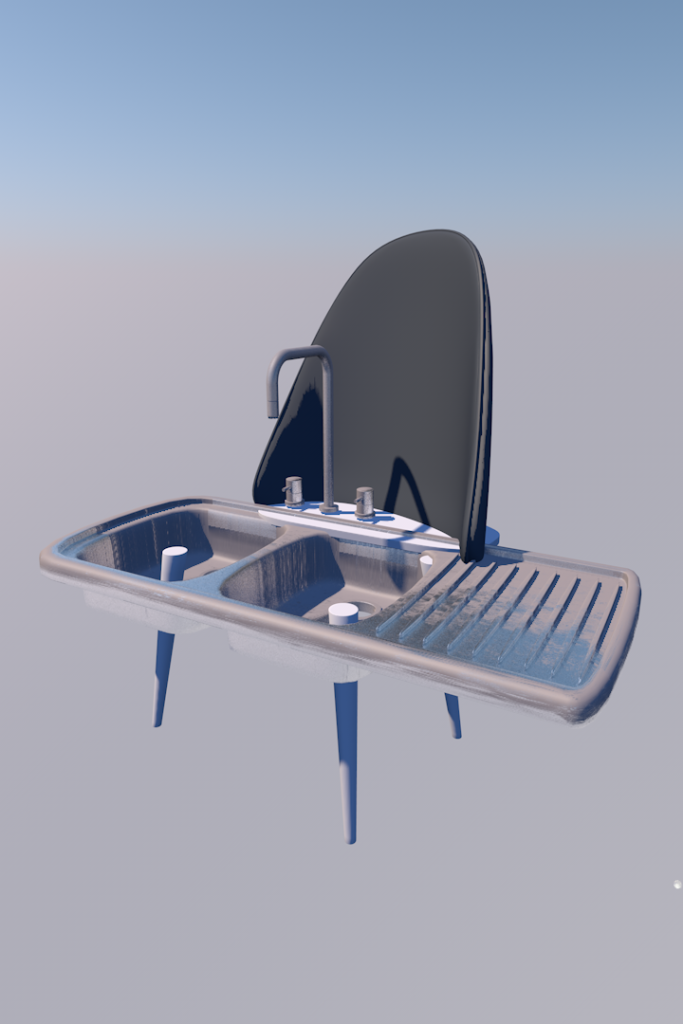
For my project, which is to interrogate the meaning of 3D models and software, I gradually developed a viewpoint that the 3D models represent and, in a sense, replace some parts of reality. The media, in this case, challenged reality and reformed the way we interact with others and the environment.
Pull Up a Chair
Matthew Pugh on the use and potential of chairwork.
From: The British Psychological Society
The article explains “chairwork” as a technique that various psychological treatments and disciplines have adopted. While applied as a therapeutical method, the technique mainly focuses on the individual’s self-reflection and internal conflict. According to the article, chairwork practice includes three main steps. The first step is the “empty-chair” practice. The therapist would ask and encourage the patient to imagine the “other” in the empty chair and have a dialogue with the “other”. The “other” could be symbolic subjects or actual persons. Then in the second step, the “two-chair” practice, the patient would be asked to perform different perspectives by shifting between two seats. In the end, the therapist may help individuals address the appeared problems, which is the final step. The result of this practice may help individuals for a better understanding of past events, reality testing for the present and future rehearsal, or gain perspectives from others. The chairwork technique is a psychological practice that applies another layer of meaning to the chair. In practice, the chair becomes a medium that has individuals project their imagination. Since my project started to focus on the chair itself, the theory of the chairwork technique inspired me to re-examine the function of the chair.
Practice&Project:
HOMESCHOOL
By Simone C Niquille / Technoflesh
The project HOMESCHOOL by Simone C Niquille is a short 3D animation film that presents the computational vision generated by the dataset. The video shows two sets of images. One set of images is rendered in gradient, which suggests the Z-depth in 3D images. Human eyes can recognise the gradient as the depth within images, but they are difficult to read by computer. Another set of blurry images is rendered by 3D software and filtered with an artificial intelligent demonising filter, which the filter would remove and reduce some of the information that is contained in each image.
The result from rendering through trained datasets leads to a vision that only already named subjects can exist. It has been mentioned in the HOMESCHOOL, ‘Language, in this case, is not a tool for searching, describing but rather a tool to exclude everything that does not have a name.'(technoflesh Studio, https://www.technofle.sh/hs/homeschool.php). HOMESCHOOL is closely related to my project at this stage because I am searching for ways different from our usual vision, that is, to explore ways of communication, interpretation and the use of languages. This project inspired me to see the meaning of language itself and enabled me to experiment further with the relationship between 3D forms and texts.
100 Chairs in 100 Days
By Martino Gamper
100 Chairs in 100 Days is a project done by Martino Gamper, with a collection of 100 chairs using found materials from London streets and friends’ homes. Gamper’s chairs could be viewed as 3D sketchbooks that explore the possibilities of functional and useful chairs. While creating each chair, Gamper connected and assembled materials with various styles and structures to present a series of hybrid versions of chairs that we usually perceive in our daily lives. This project reminds me of Dunne & Raby’s concept of “fictional design” from my previous research. Both of their projects aim to open up more potential than one existing restricted idea.
Not only to interrogate the contemporary ideas of chairs, but Gamper also addresses that he wants to celebrate the chairs’ origins through his design. Those chairs deliver stories behind them. Gamper’s aspect provides answers to part of my question from my project. 3D models are not like found materials. They mimic reality and create stories for viewers. The textures and materials that apply to each model could be varied, can then the stories would shift.
Extended Critical Analysis – 100 Chairs in 100 Days
According to Gamper, his motivation to create such a project is not about saving the unwanted chair or merely making chairs for his own satisfaction but the process of making. The intention for Martino’s chairs is not aiming to fit into the contemporary concept of the perfect chair. Instead, he focuses on exploring the limits and possibilities of making chairs within the restrictions provided by found materials and time limits. As Gamper has explained, creating within restrictions motivates him to generate this project. This idea resonated with me during the Positions Through Contextualising, in which I found myself drowning in the large swamp of philosophical questions.
Gamper’s position is to question the contemporary criteria of ‘The Best’. Then the question can lead to discussion and debate around tangible and intangible values of chairs that are affected by their styles and function. To indicate this idea, Gamper chooses to work with found materials so that each chair presents a combination of styles. In this case, styles become indescribable, and the status that appears along with the styles fade away. For example, Leg-o (2007) indicates a chair assembled with several different kinds of wooden legs. There are various styles, from the piece showing delicate cuts and elegant curves to a simple stick. Leg-o and other pieces in this project demonstrate the idea that there is no such ‘The Best’ since everything is a hybrid.
Gamper’s hybrid technique is also demonstrated through the functionality of each piece. The project sculpts out the variation of chairs that may or may not mean to be seated. The piece Bare Light (2016) challenges the definition of the chair by combining a lamp with a chair frame. Martino blurred the boundary between chairs and other kinds of furniture by introducing an unexpected function.
Through 100 Chairs in 100 Days, Gamper introduces the complex idea by utilising simple and easily required materials. A similar methodology is adopted in the practice of graphic communication design field as well. As I have mentioned in the Annotated Bibliography, Dunne & Raby’s project adopted a similar method of combining existing materials. In TECHNOLOGICAL DREAMS SERIES: NO.1, ROBOTS, 2007, the designers position themselves in the future and introduce four robots that exist as “technological cohabitants”. The project raised questions about the future relationship between humans and the robots. In the video All the Robots, the designers used simple materials to represent each robot and have these materials perform basic movements like moving horizontally on the floor or rolling on the ground to illustrate their concepts. The project combines simple materials and movements to create an effect that demonstrates complex concepts.
Despite the choice of materials, Gamper’s idea of working with restrictions is also demonstrated through Dunne & Raby’s robots. The four robots are created to respond to each of the aspects of the relationship between robot and human——subservient, intimate, dependent, and equal. Each robot only responds to one kind of quality, which makes the idea become straightforward to the viewers. The method of creating with constraints enables designers to remove distractions for audiences to achieve a better communicative result.
Extended Critical Analysis – The Age of Earthquakes: A Guide to the Extreme Present
The Age of Earthquakes demonstrates how human society has been shaped and driven to a world where we somehow lose control of our daily lives. The book is illustrated with a large number of images and blown-up texts to create an experience of scanning through social media. The design of this book clearly suggests its position. The book (Basar, S., Coupland, D., and Obrist, H., 2015, p. 1-11) start with a short description of reader receiving and email and then listed out several numbers of internet energy usage by comparing the numbers with the world’s total electricity, world aviation, and stating the fact that our electronic life causes the number of carbon fuels that could melt the ice caps. By showing aircraft and earthquake images along with striking descriptions, the book revealed its title again to almost shouting at viewers how madness our world become.
As the title states, the book is A Guide to the Extreme Present. The quality of the guide, which is to advise, show and indicate ideas, is embedded in the design. For example, the book introduces the concept of life feeling short and fast, and time seems to be shrinking due to the internet. Each description is paired with the image or large text to indicate the idea. Like the large italic text “TIME REALLY MOVING FASTER” (2015, p. 28-29) or the image of kittens in the space (2015, p. 31), and then the book reassures the idea.
The book not only suggests the concept in its content by giving words such as Chinosis and giving out an explanation (p. 195) and examples of Shetha_Cute111 posting selfies on social media but also in its form, in other words, the design. There are pages that show a Google search bar (p.39), left and right click buttons (p. 120-121), and other kinds of webpage elements to suggest that we are living in a world wrapped by the internet.
To address the graphic communication design practice, the book demonstrates an example of its design is shaped by the practice. From a viewer’s and also a graphic designer’s perspective, the book is well executed. The choice of large texts and images allows readers to digest the content easily. While reading through this book, the arrangements of various size of texts provides readers with a rhythm to reading, in which the content becomes more appealing and pleasant than books full of small texts. For example, the hypothesis of dating with yourself (p. 162-163) is designed with two pages of small text. The pages before and after this section appear with large slogans. Then this series of layout repeat in the following few sections, with the small description texts starting with “Imagine…” along with the large texts and images before and after these pages (p. 240-245).
From the design to the layout of The Age of Earthquakes, the book clearly suggests the thinking of graphic communication design in every aspect, for it creates and presents reading experiences for readers.
Citation List
Blauvelt, Andrew. Maurer, Luna. Paulus, Edo. Puckey Jonathan. and Wouters, Roel. (2013) Conditional Design Workbook. Amsterdam: Valiz, pp. ii-xiv.
Chun, Wendy Hui Kyong. (2018) On Patterns and Proxies, or the Perils of Reconstructing the Unknown. Available at: https://www.e-flux.com/architecture/accumulation/212275/on-patterns-and-proxies/ (Accessed: 17 May 2023).
Basar, S., Coupland, D., and Obrist, H. (2015) The Age of Earthquakes: A Guide to the Extreme Present. London: Penguin Books.
The British Psychological Society (2017) Pull Up a Chair. Available at: https://www.bps.org.uk/psychologist/pull-chair (Accessed: 8 May 2023).
technoflesh Studio (no date) HOMESCHOOL. Available at: https://www.technofle.sh/hs/homeschool.php (Accessed: 3 May 2023).
Simone C Niquille (2019) HOMESCHOOL [Digital art]. Available at: https://www.technofle.sh/hs/homeschool.php (Accessed: 3 May 2023).
Sueda, J. (no date) ‘All Possible Futures: (Un)Realized Projects’, TASK Newsletter (2), Excerpt. Available at: http://allpossiblefutures.net/ (Accessed: 23 April 2023).
Martino Gamper (no date) 100 Chairs in 100 Days. Available at: https://www.martinogamper.com/project/a-100-chairs-in-a-100-days/ (Accessed: 4 May 2023).
©Martino Gamper & åbäke (2007) Leg-o. Available at: https://www.martinogamper.com/project/a-100-chairs-in-a-100-days/ (Accessed: 4 May 2023).
©Martino Gamper & åbäke (2006) Bare Light. Available at: https://www.martinogamper.com/project/a-100-chairs-in-a-100-days/ (Accessed: 4 May 2023).
Dunne & Raby (2007) TECHNOLOGICAL DREAMS SERIES: NO.1, ROBOTS, 2007. Available at: https://dunneandraby.co.uk/content/projects/10/0# (Accessed: 17 May 2023).
Dunne & Raby (2007) All the Robots [Cinemagraph]. Available at: https://dunneandraby.co.uk/content/projects/10/0# (Accessed: 17 May 2023).