
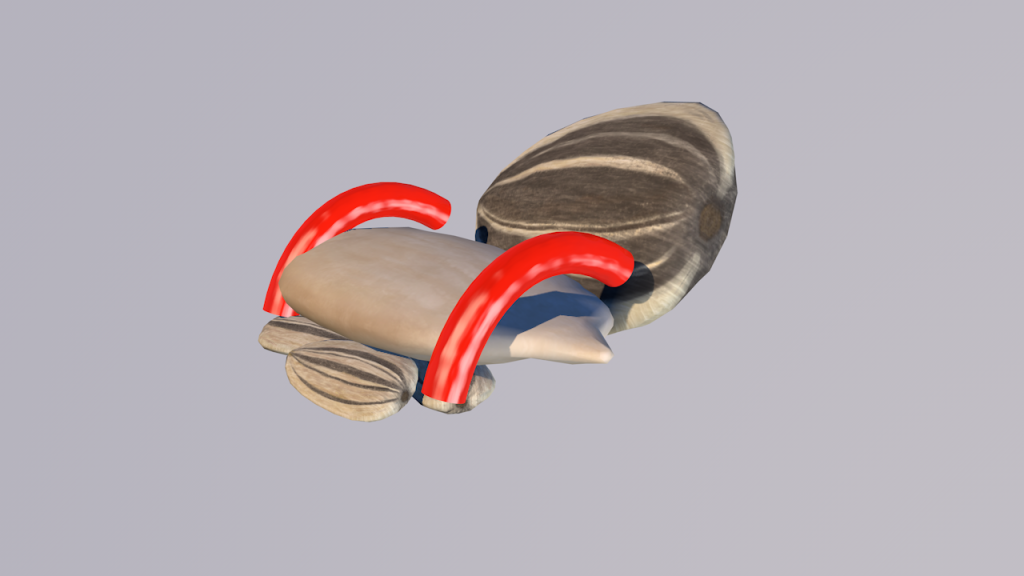
Can a 3D chair be more ‘real’ than the one you are sitting on?
The 3D models can be regarded as the extension of reality, and many of them are made to represent real objects. However, 3D chairs are not like real chairs, and we cannot actually sit on them.
What makes 3D chairs look real, and what makes them unreal? I want to address this idea with the models of chairs I have created. They are made in response to the real action of humans, but they also extrude the definition of “chair” by their forms and materials.
Can Blender or any other kind of software be regarded as extensions of humans? We create the extensions of our reality with the extensions of our hands.
To address the questions above, I started to develop a set of 3D models of ‘chairs’, that are made in response to the real actions of humans, but they also extrude the definition of “chair” by their forms and materials.
I started to picture some chairs like a chair with light. It can provide as much light as you want.
Or a chair with a sink. It can help you to wash things whenever you wish.
Or even a cushion chair that is full of cushions.
There are more: leaves chairs that provide an experience with green plants while sitting around with friends.
The floating chair. A chair that can float. VR headsets chair that provides you with tons of VR headsets.
However, they are just some ideas thrown on the chair.
During this journey, there soon appeared a loophole in my design process. I neglect the symbolistic feature that is embedded within chairs. A chair is not a neutral object. The chair is the symbol of social status, priority and power. Starting from here, I focus my project on addressing a practice in China that females cannot share the same table with men during dinner banquets. The first set of designs tempts to suggest the anguish of females from this practice. The design focuses on the elimination, boundary, and violence that males performed against females. Therefore, the first set of 3D models I created addressed the issue in a sarcastic tone with design elements such as spikes and cages. However, I soon found out they stated the fact that females have no seats at the dinner table, and the 3D models of chairs merely replicated the reality. What I want from this project is not simply to state the facts but also to propose an alternative way of sitting for females. The intention of the second set of designs, therefore, turned to reimagining comfortable sitting spaces for women.