
From Reading Lists:
The Work of Art in The Age of Mechanical Reproduction
By Walter Benjamin
The chapter describes and lists the changes that the film and photography brought to the viewers. Film and photography unleash the restriction from early traditional aesthetics that are controlled by the authorities and institutions. Mechanical reproduction, in which film and photography are the best representations, occupied art production. In my project, I adopted the media Blender, which could be put in the context of “film”. Similar to what Benjamin described in the film, the images I have rendered and presented are the assembly of camera angles, lighting, frame sizes, cropped objects and selected text forms. I built the aesthetic for this 100 pages publication with all these elements. According to Benjamin, the film or photography of subjects excludes the “aura” from them, which the point raises the question: what is the “aura” of a 3D object in Blender? Is the “aura” their form and textures that apply to them or their original actual forms from reality? Not only I presented the part in a 3D form but also the texts in this project. Then what is the aura of the texts? If the “aura” means something that is contained within its original piece, then my project is eliminating the “aura” from texts and forms. However, not only eliminated the meaning by distorting, cropping and framing, but I was also able to apply meaning to the original subject.
The Medium is the Massage
By Marshall McLuhan and Quentin Fiore
Similar viewpoints exist between The Medium is the Massage and The Work of Art in the Age of Mechanical Reproduction. Both books reflect and examine the changes that new technology brings to individual lives and the holistic human society. In The Medium is the Massage, however, the attitudes towards new media and technology are slightly more optimistic than Benjamin’s opinion. While Benjamin views the film removes the “aura” from their original subjects, The Medium is the Massage introduces the media as an extension of human perceptions, which change our thoughts and actions in reflection of this world. The Blender could become a tool and media that become an extension of reality. This specific tool enables me to alter the texts and 3D forms through the extension version of hands and visions. Then the images I created through Blender could be viewed as an extension of my mind. To view this in a border context, the images become the extension version of the human mind. Through the extension, I could then connect and disconnect the texts and 3D forms in different ways to deliver messages different from the perspective we, as humans, typically have.
Practices & Projects:
Lawrence Weiner
Lawrence Charles Weiner was an American conceptual artist and one of the renowned figures associated with the conceptual art movement. His work usually engaged with texts and words that explore and experiment with the way the audiences interact with the language. In Position Through Iterating, I am also using texts and forms of words to experiment with the experiences that I could bring to the viewers.
Since many of Weiner’s work does not necessarily do by himself ——they might be painted by sign painters, and the form of his work always changing according to each specific site where the work is installed, Weiner created a relationship between each site and his work through the choice of medium and context.
I found Weiner’s method of adopting the environment and circumstances inspiring. I intend for this project to create text forms that respond to and create messages with 3D objects. I need to consider the texts and the 3D objects that they are going to apply carefully to convey the meaning through their relationship.
One and Three Chairs 1965, by Joseph Kosuth
The work done by Joseph Kosuth, One and Three Chairs, has me questioned and considered the way we perceive, present and describe a subject. The work One and Three Chairs includes a photograph of a chair, the chair, and a dictionary definition of the word “chair”. Kosuth created this work to ask the viewers to question and re-examine the concept of “art”. Though in my project, I am not focusing on the concept of “art” itself, One and Three Chairs raises a point that relates to my concept. The work presents three aspects of the subject “chair” with one written definition (dictionary definition), one object (the chair), and one visual interpretation (photograph), which all three aspects could represent the “chair”. Then where are their differences while we adopt them? The question has me re-consider the meaning of the 3D models and the texts of the chair that I adopted in my project.
Own Research:
Laws of Media The New Science
By Marshall McLuhan and Eric McLuhan
The book slightly addressed the senses of humans and how humans perceive the environment. The Figure and Ground concept, originally from Gestalt psychology, is adopted in the book and broadened to describe human perception. According to McLuhans, ‘figure’ and ‘ground’ are two elements that coexist, though ‘figure’ grasp more attention, and ‘ground’ is neglected. The ‘ground’ defines that tone and context, and then it appears the ‘figure’. The concept is not such an unacquainted idea to me. To understand it through certain contexts, for example, while painting, I need to consider the structure and the environment to set the subject in the scene. The ‘ground’ become the scene and the environment, and the ‘figure’ is the subject of my painting. However, while working with Blender, or other kinds of 3D modelling software, I tend to ignore the ‘ground’ and only pay attention to the ‘figure’. The ‘ground’, in this case, not only suggests the background or the scene but, in a much broader context, the whole structure of the awareness. In Position Through Iterating, the most effective part is the position that I take, which can become the ‘ground’ for this project. The book provides me with the consciousness of paying more attention to the ‘ground’ instead of the ‘figure’.
All Possible Futures: (Un)Realized Projects
The article includes seven interviews with several designers based on their projects. The conversation mainly started with each project’s speculative aspects and then expanded to a more specific discussion about each designer’s practice.
Reading through the survey helped me gain insights into the projects and the ideas from their designers. For instance, Dunne & Raby address their concept, and the intention for their design is to design for fictional circumstances, in which the purpose is to open up more possibilities other than the fixed “reality”. In other words, they are proposing another time and space in which the future is part. Dunne & Raby’s concept relates to some of the ideas suggested by McLuhan in The Medium is the Massage in terms of how we perceive and understand the new media, that we cannot have them fit in the restrict “now”, but to open up our perspectives and embrace other possibilities.
Learning from different designers through the interview enables me to see my project from a different viewpoint, especially to see it as a potential speculative design project.
Project Statement
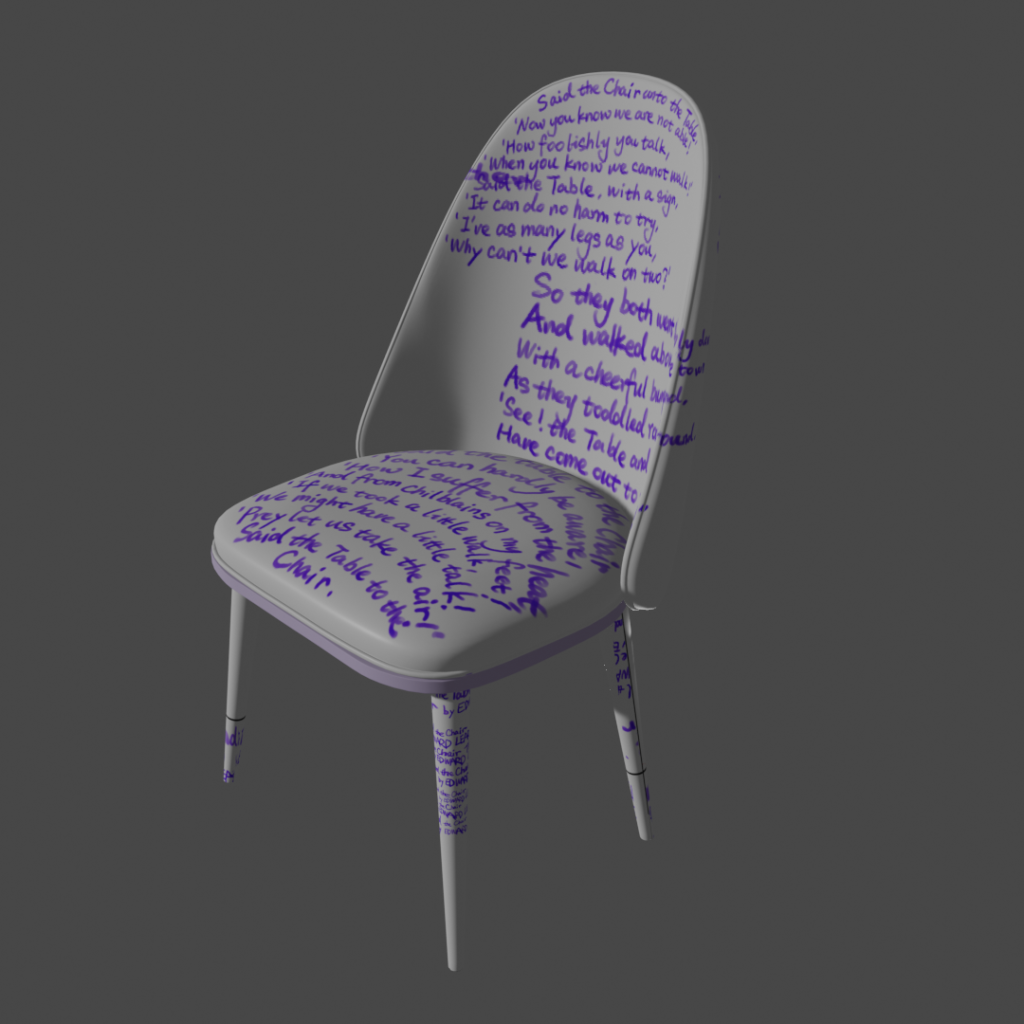
In this project, I use Blender as my media to start with and use it to apply text forms on 3D models to create a distorted version of texts. Some words and sentences become difficult to read, and some turn into unreadable patterns. However, the text forms, along with the 3D models, built a perceptible layer between the form and the text.
My goal, at this stage, is to challenge the way we perceive and communicate in “reality” with virtual objects and text forms. There are examples of real estate companies using rendered images instead of photographs to sell properties. Under this context, the rendered image of a chair becomes an “actual” chair. Then what are the differences between a 3D model of the chair and the chair I am sitting on? While I am using the word “chair”, does it mean that the “chair” I am adopting here is the actual chair? These questions create a dilemma of the reality and what is not. If we can see all these chairs with a shifting perspective, they can all be the reality or vice-versa.
Citation List
Benjamin, Walter. (1969) ‘The Work of Art in the Age of Mechanical Reproduction’ Illuminations. New York: Schocken Books, pp. 1-26.
McLuhan, M. and Fiore, Q. (2001) The Medium is the Massage: An Inventory of Effects, Berkeley: Gingko Press.
Solomon R. Guggenheim Foundation (no date) Lawrence Weiner. Available at: https://www.guggenheim.org/artwork/artist/lawrence-weiner (Accessed: 24 April 2023).
Tate (no date) Lawrence Weiner 1942-2021. Available at: https://www.tate.org.uk/art/artists/lawrence-weiner-7743 (Accessed: 24 April 2023).
MoMA (no date) Joseph Kosuth One and Three Chairs 1965. Available at: https://www.moma.org/collection/works/81435 (Accessed: 24 April 2023)
McLuhan M. And McLuhan E. (1988) Laws of Media: The New Science. Toronto: University of Toronto Press.
Sueda, J. (no date) ‘All Possible Futures: (Un)Realized Projects’, TASK Newsletter (2), Excerpt. Available at: http://allpossiblefutures.net/ (Access: 23 April 2023).