
Script:
The project starts with Iterating. A small part of this project. A small part of this model. I did not notice this until I really zoomed in on the model and saw all the structures and text forms.
I highlighted this sentence in The Medium is the Massage by Marshall McLuhan “The main obstacle to a clear understanding of the effects of the new media is our deeply embedded habit of regarding all phenomena from a fixed point of view.”
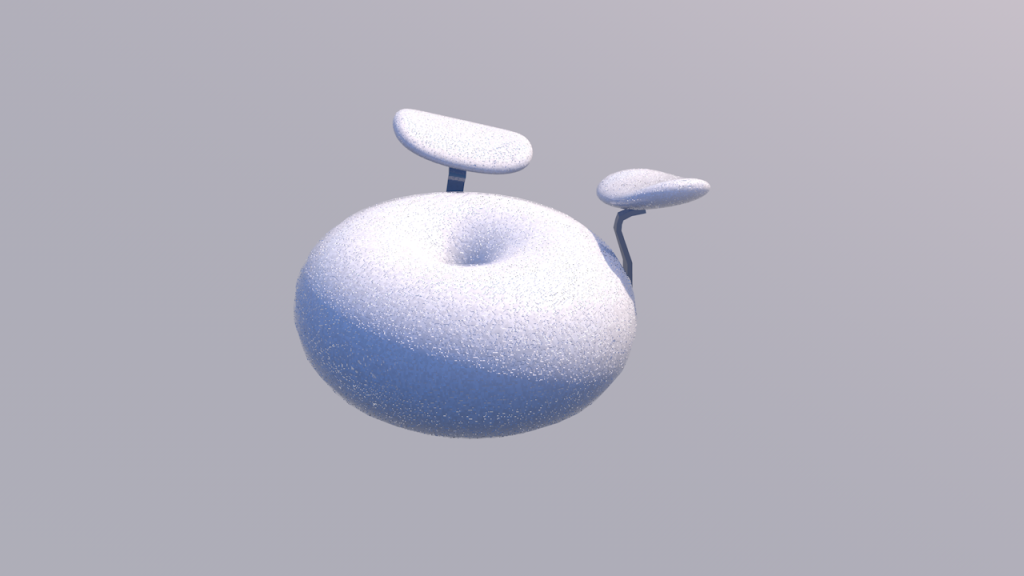
This is a chair and also a 3D model of a chair.
The 3D models can be regarded as the extension of reality, and many of them are made to represent real objects. However, 3D chairs are not like real chairs, and we cannot actually sit on them.
What makes 3D chairs look real, and what makes them unreal? I want to address this idea with the models of chairs I have created, that They are made in response to the real action of humans, but they also extrude the definition of “chair” by their forms and materials. (Enquiry)
Project One and Three Chairs by Joseph Kosuth includes a photograph of a chair, the chair and the dictionary definition of a chair to question the way we perceive, interpret and describe the object chair. 3D models are also a way we perceive and interpret objects.
In response to my thinking process, I created this zing —— What Do You See? What do you see through all these different interpretations of the chair?
From McLuhan: All media are extensions of some human faculty—psychic or physical.
Can Blender or any other kind of software be regarded as extensions of humans? We create the extensions of our reality with the extensions of our hands.
Because my project now focuses on the chair, I want to know more about chairs rather than just an object that provides seats for people.
There is a psychological therapy technique called “chair work”.
During the practice, the therapist asks the client to imagine the “other” in the empty chair and have a dialogue with the “other”. “Other” can symbolise something or an actual person.
Then the client would be asked to perform different perspectives by shifting between two chairs.
At last, the therapist would work with the client to address the existing problems during this process.
In this therapy, the chair becomes the medium for people to project their imagination.
And Chairs become the extensions of the “other”.
I start to picture some chairs like a chair with light. It can provide as much light as you want.
Or a chair with a sink. It can help you to wash things whenever you wish.
Or even a cushion chair that is full of cushions.
There are more: leaves chairs that provide you with an experience with green plants while sitting around with friends.
The floating chair. A chair that can float. VR headsets chair that provides you with tons of VR headsets.
However, they are just some ideas thrown on the chair.
In 100 Chairs in 100 Days, Gamper said that the key to his motivation is the restrictions. The restrictions are on the materials, the styles and the time limits for creating 100 Chairs, each unique in its own way.
I also need some constraints. Then I saw my friend play Zelda. Since she is around, I decide to design 3D chairs for Switch Player. I spend days observing and found these gestures appearing all the time.
In responding to these gestures, I start modelling.
The restrictions for me are to respond strictly and reflect on the gestures I have found. The point is trying to have the objects reflect on the needs instead of having them fit in the context of “what does a chair look like?”.
The intention of creating these models is to focus on the differences between the 3D models and the reality. I used the Zing format again to show these three models’ processes and concepts.
The chairs I have created are in response to reality, but the chairs exist as virtual objects, which are shown as images and videos at the end. Then, I want to ask: how can we actually use these chairs in a virtual space? If they are extensions of reality, then what is the extension of the action “seating” be like? There are more questions that need to be addressed. This project is not finished at this point. I want to further research the 3D models in terms of their materials and forms that affect how we perceive, communicate and interact within this world.
Citation List:
McLuhan, M. and Fiore, Q. (2001) The Medium is the Massage: An Inventory of Effects, Berkeley: Gingko Press.
MoMA (no date) Joseph Kosuth One and Three Chairs 1965. Available at: https://www.moma.org/collection/works/81435 (Accessed: 24 April 2023).
The British Psychological Society (2017) Pull Up a Chair. Available at: https://www.bps.org.uk/psychologist/pull-chair (Accessed: 8 May 2023).
Martino Gamper (no date) 100 Chairs in 100 Days. Available at: https://www.martinogamper.com/project/a-100-chairs-in-a-100-days/ (Accessed: 4 May 2023).