
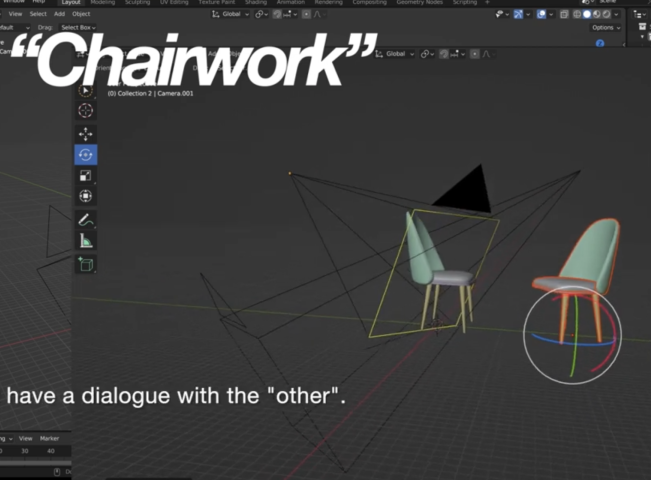
My project intends to draw the difference between virtual space and reality. I utilise a series of 3D models of chairs that I created to indicate the intention visually. The 3D model could be seen as an extension of the reality, but they are different from the reality.
The paragraph above is the enquiry that I have developed in the Positions Through Essaying. It is clear that the enquiry at this stage needs many improvements, and this concern is also raised in the conversation with Nina Paim.
There are amount of chair models that I have created in this project in response to some specific needs. Even though the subject is clear —— the chair, the subject that emerges those needs are undefined. According to the conversation, Nina points out that I need to define “we”. Who is “we”? Who has the needs? What specific needs do “we” have? Though I may have reflected some needs from my own perspective and position, they are still way too vague and too general. There are differences between humans, and there are different kinds of people with different needs. In order to improve the enquiry, the first step is to define and raise questions about “we”.
Then, the conversation continues by addressing another subject in my project —— the chair. Nina provides another perspective about chairs that had not come to my mind while I was working on this project. She asks me, “Why the chair?”. My reason for choosing the chair is that the chair is an everyday object, and it appears almost everywhere as long as there are human beings. As I have explained, the undertone here is that I regard the chair as a neutral object. However, Nina holds a different opinion that the chair is not a neutral object. The chair is created and defined by people. For example, I quoted a line of the dictionary chair definition in the zing as an objective description of this object. Nina explained that though the sentence seemed objective and neutral, it was edited and written by someone. Therefore, the descriptions and definitions that came across to me during my research hold certain perspectives even though I did not realise them.
To understand the chair batter, Nina suggested I research the subject more. For example, I can dig into the historical facts of the chair. Furthermore, the definitions and meanings of chairs differ in various cultures, which I did not cover in my previous research.
The conversation with Nina Paim helped me to see the blind spot during my research process. With the advice from Nina, I have a clear direction for improving the enquiry.
The outline of the enquiry is to focus on the differences between reality and virtual space. I attempt to achieve the enquiry by creating a series of 3D models of chairs to reflect the “needs”. To improve the enquiry, I should focus on one specific group that emerges the needs and then reflect on only a few numbers of the needs. While creating the model, I need to consider the design of the chair by referencing the historical and cultural context of the chair.